
Can AI Strip You of Your Self-Confidence or Build You Up?
Close your eyes. Take yourself back to school — that tween or young teen version of you sitting in a classroom where one student always seemed to get everything right. Effortlessly. Perfectly. What went through your mind at the time? How did you feel? Or, were you that student? Now fast forward. Your first presentation […]
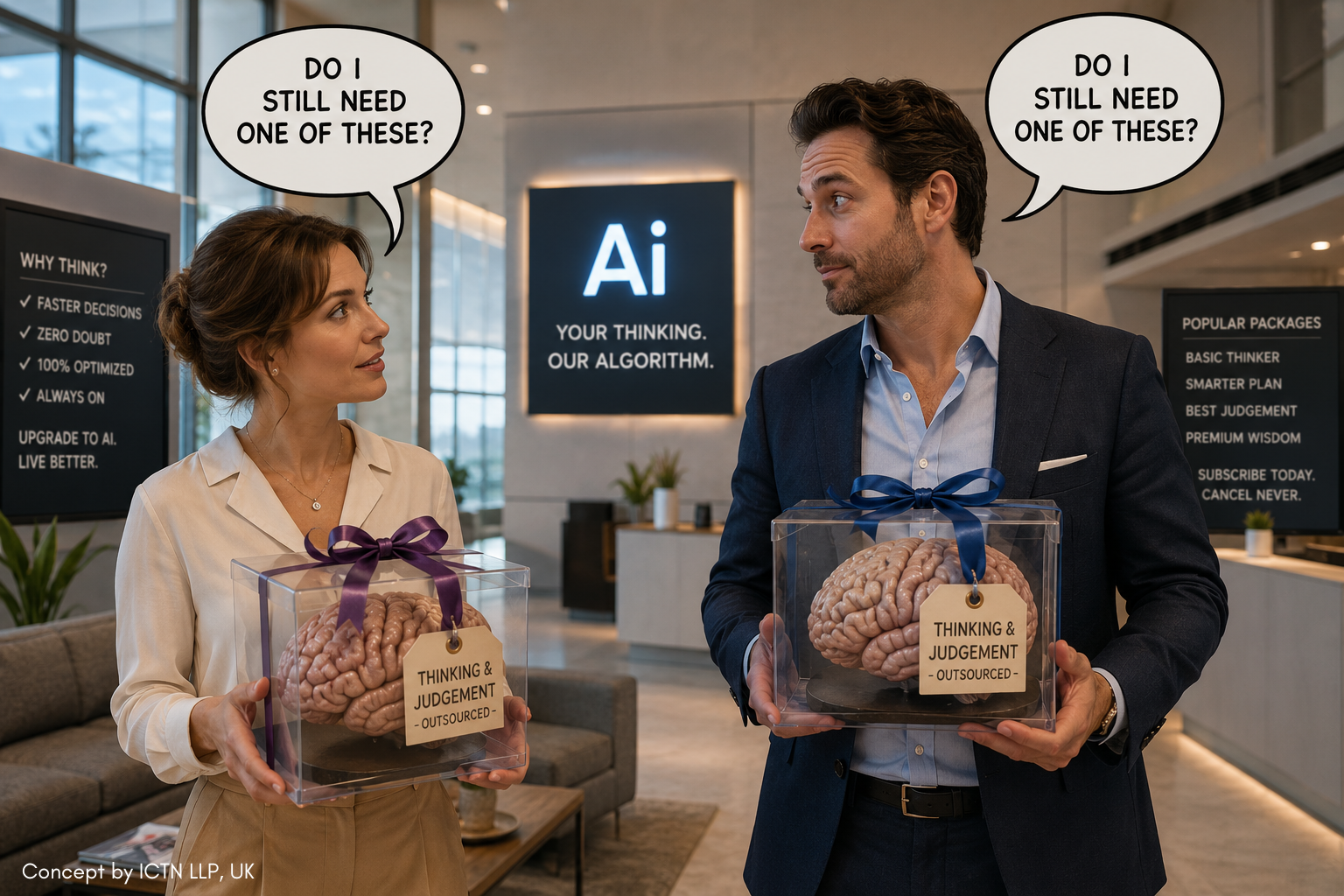
Close your eyes. Take yourself back to school — that tween or young teen version of you sitting in a classroom where one student always seemed to get everything right. Effortlessly. Perfectly. What went through your mind at the time? How did you feel? Or, were you that student?
Now fast forward. Your first presentation at university, hands trembling slightly. Your first job interview, rehearsing answers in the mirror the night before. That was before you could get instant AI responses to the questions. That international conference where you somehow ended up on a podium in front of hundreds of people. No beautiful AI generated slide deck.You had to understand and create it yourself.
And what about the first time you told someone you liked them? Really liked them?
Every one of those moments asked something of you. They were uncomfortable, exposing, sometimes humiliating — and they built you. The stumbles, the recoveries, the “I can’t believe I just did that” moments are the scaffolding upon which your self-confidence was built. They’re yours. Nobody else lived those experiences.
So here’s the question worth sitting with: when you use AI to get your work done — to write, to think, to present ideas that land brilliantly — what happens inside you when you know the brilliance wasn’t entirely yours?
Does it quietly wake up your imposter syndrome? Does it feel like getting away with something? Or do you just shrug and move on?
Before you answer, try this. Think of a recent moment when AI did the heavy lifting for you. Now name three emotions you felt in that moment. Don’t reach for the “right” answer — reach for the honest one. Write them down.
If nothing surfaces, here’s a prompt list to borrow from: glee, self-doubt, anxiety, satisfaction, guilt, confidence, inadequacy, unworthiness, invincibility, inferiority.
How many did you recognise? The higher the number, the more your relationship with AI is actually telling you something about your relationship with yourself.
Now let’s look at three ways that relationship tends to play out.
When AI diminishes your confidence — you start outsourcing not just tasks but judgment. You stop trusting your own instincts because the AI version always seems more polished. We confuse content with form. Over time, the gap between what you produce with AI and what you believe you can produce alone quietly erodes your sense of capability.
When AI builds your confidence — it becomes a rehearsal space. A thinking partner. It helps you organise what you already know, pushes your ideas further, and frees up mental energy for the work only you can do. You show up sharper, not smaller.
When AI is simply a tool — you’re the one holding it. You decide when to pick it up and when to put it down. It serves your thinking rather than replacing it. This is the most honest and most powerful position to stand in.
Here’s the truth: every transformative technology has asked us to renegotiate our sense of self. This one is no different.
Learn what AI is. Decide deliberately how you want to use it. But never — not for convenience, not for speed, not for the appearance of brilliance — trade away the irreplaceable power of being fully human.
Your imagination. Your capacity to feel, to connect, to create from lived experience. These are not features any model can replicate.
Your humanity is not a limitation. It’s your greatest asset. It is your identity. Develop it. Protect it. Cherish it.