
Blog
Reimagining the Office for Hybrid Work Success
The great hybrid experiment is over; the messy, complicated reality is now the status quo. Yet, we are attempting to solve this new equation with an old formula: the pre-2020 office. This is a fundamental mismatch. When work is no longer mandated but elective, the physical office can no longer be a default location. It must become a destination.
The companies leading this shift understand a simple truth: you cannot simply “plug” hybrid work into a sea of cubicles and expect collaboration to flourish. They are systematically deconstructing the uniform office and replacing it with a portfolio of purposeful spaces. The goal is not to replicate the video call from home at a desk in the office, but to offer what remote work cannot.
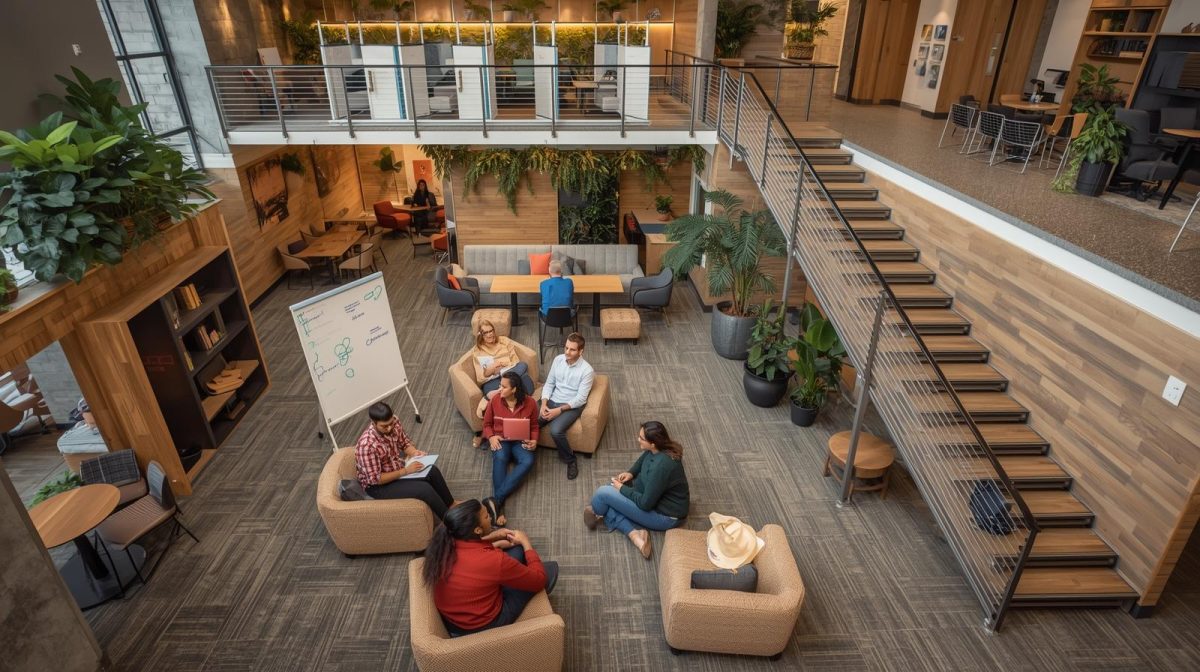
This new “un-office” is characterized by intentional design. The serendipitous hallway conversation is no longer left to chance. Office space is engineered to provide the ecosystems that promote social interactions, meaningful interpersonal communication and other collaborative functions that matter to the people working within that organization. These purposefully designed spaces offer what remote working does not:
- Conversation spaces, strategically placed “collaboration hubs” stocked with whiteboards and comfortable seating.
- A peaceful and quiet environment that enables deep focus, often impossible in a noisy home, is served by bookable “focus pods” and library-quiet zones.
- Spaces designed to foster the social cohesion that screens struggle to build—a well-appointed cafe, a town hall atrium, a workshop space.
These are the amenities that now justify the commute.
The underlying principle is a shift from real estate management to experience curation. The office’s value is no longer measured in square footage per employee, but in the quality of connections forged and the problems solved there. It must be a magnet, not a mandate. It must earn its commute. The organizations that thrive will be those that stop asking “How do we get people back to the office?” and start asking “Why should they choose to come?” The answer lies in building a space that actively works for them.
About Author

You might also like

Navigating Cross-Cultural Leadership: A Guide for Global Executives
In today’s globalized business landscape, the skill of leading cross-culturally is not just beneficial but essential. Global executives face the unique challenge…

The Motherhood Influence: Shaping Next-Generation Leaders
The influence of motherhood on the development of future leaders is profound and multifaceted, touching every aspect of leadership skills, from emotional…