
The Human-Capabilities Supply Chain: An Underestimated Risk
We speak of supply chains for goods, for components, for data. But we have neglected the most vital one of all: the Human-Capabilities Supply Chain. This is the intricate, fragile network through which we pass down the qualities that make a civilization. And its fundamental law is this: money cannot buy everything. Some assets are […]
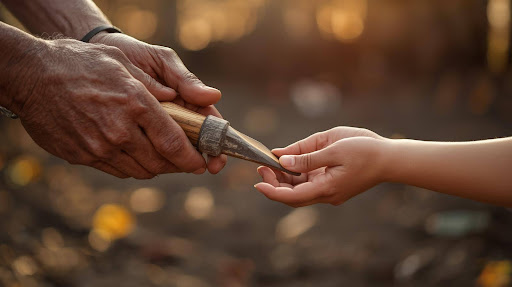
We speak of supply chains for goods, for components, for data. But we have neglected the most vital one of all: the Human-Capabilities Supply Chain. This is the intricate, fragile network through which we pass down the qualities that make a civilization. And its fundamental law is this: money cannot buy everything. Some assets are currency-proof. They are earned only through time and continuity, generation after generation.
Consider the master craftsperson. You can fund a workshop, purchase the finest Italian wood, the sharpest German steel. But you cannot purchase the instinct in the hands, the eye that sees the grain in the wood before a cut is made, the patience that was learned at a grandfather’s bench. Add the subtleties of aesthetics and ergonomics that were translated into the creative production. These are dividends paid out over decades. It is a capital of quiet knowledge, compounded annually through observation and repetition.
This principle extends beyond workshops. It lives in the farmer who understands the soil not from a textbook, but from a childhood spent reading the sky and the earth. It resides in the community where trust is not a contractual obligation, but a living heirloom, built on the memory of shared hardships and kept promises. A nation can be financially rich but spiritually bankrupt, its shelves stocked with goods, but its soul hollowed out because the supply chain of character was broken.
We have become a society obsessed with the immediate transaction. We believe funding a program is the same as fostering a tradition. It is not. Throwing money at a problem is like trying to force a harvest; you may get a result, but it will lack the depth and resilience of something grown in its own time.
The true wealth of a people—their resilience, their integrity, their nuanced skill, their ingrained wisdom—matures slowly. It is an inheritance that cannot be bequeathed in a will, only cultivated through lived example and absorbed over a lifetime. To rebuild this supply chain requires a shift in our very gaze, from the quarterly report to the seven-generation view. We must become stewards of time, recognizing that the most precious things we can leave our children are not in the bank, but in the bone.