
Ethical leadership in the age of AI: How to make decisions that matter when they’re influenced by algorithms
In today’s world, business leaders possess extraordinary destructive power – a single decision could change everything in the blink of an eye. These decisions can be brutally logical, emotionally human and driven by the biology of survival, all at once – shaping business outcomes. As a result, ethical leadership and responsible decision-making matter more than […]
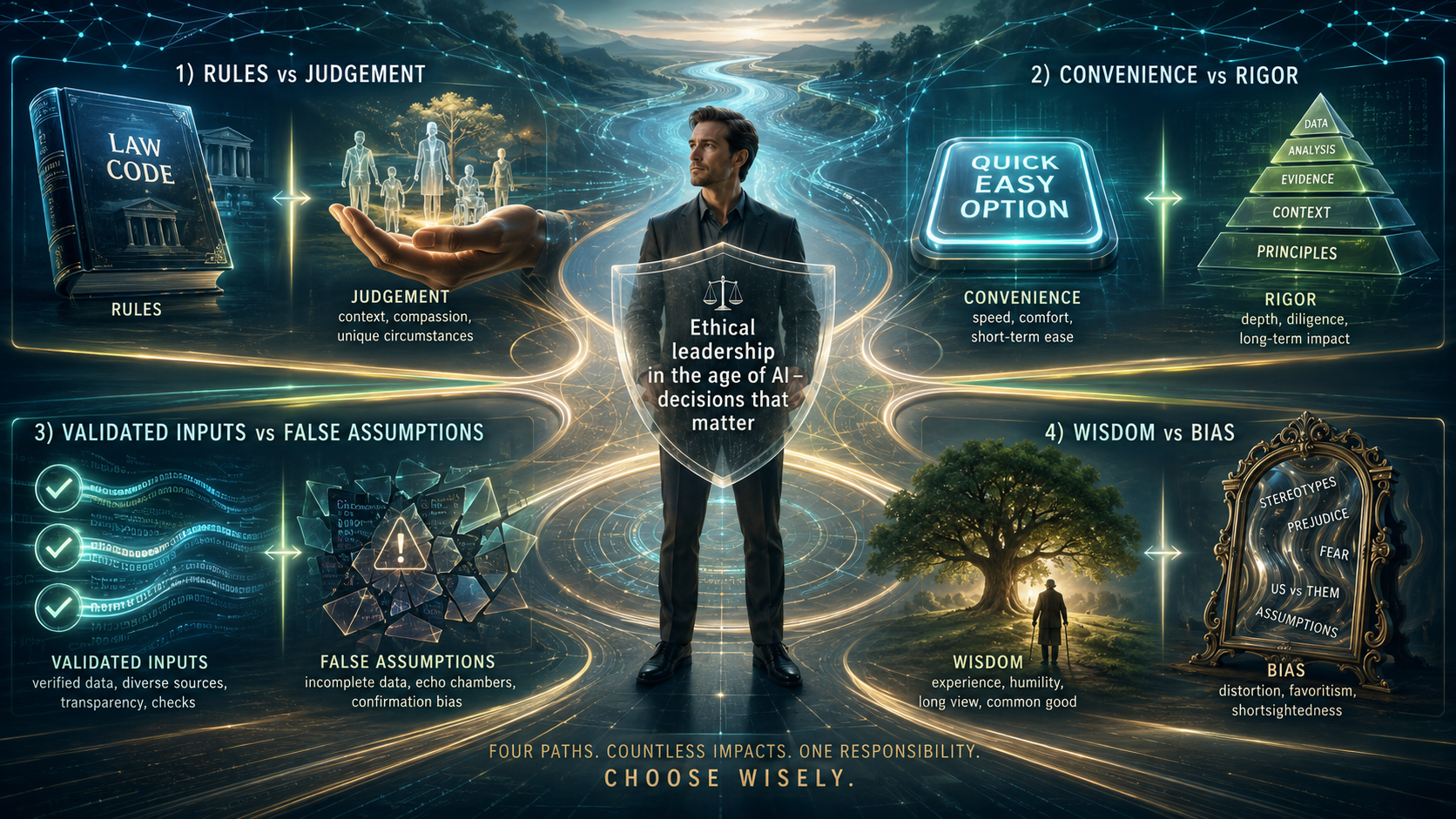
In today’s world, business leaders possess extraordinary destructive power – a single decision could change everything in the blink of an eye. These decisions can be brutally logical, emotionally human and driven by the biology of survival, all at once – shaping business outcomes. As a result, ethical leadership and responsible decision-making matter more than ever.
All decisions, whether human or machine-driven, follow algorithms. Algorithms are simply a set of rules in a process designed to solve a problem. Yet neither algorithms nor ethical frameworks rooted in current norms can guarantee the right solution. Leaders must navigate the space between rules, judgment, data and human complexity.
Below, I explore four decision-making dilemmas ethical leadership faces in the age of AI, offering ways in which leaders can consciously offset the obsequious impact of algorithms.
The four ethical leadership dilemmas I explore are:
1) rules versus judgement
2) convenience versus rigor
3) validated inputs versus false assumptions
4) wisdom versus bias.
Dilemma 1: Rules versus Judgement
Algorithms work in the background to help us solve problems. They give us a sense of false security as long as they deliver the fast and apparently reliable results we expect.
Yet this can create a false sense of security, especially when leaders overlook the assumptions underlying those systems: the frame of reference, the data used to build the rules, the unintended consequences, and the reliance on logic without empathy. The frame of reference means the decision-making model used, and the data pool refers to the source and selection of data. When these are limited or biased, leaders inherit those biases without realizing it.
In business, this tension shows up in operational processes – credit scoring, visa applications, tax systems, eligibility checks, hiring filters, and more. These systems may be highly efficient, but their outputs are not always fair or appropriate for every individual or situation.
It is often easier for leaders to follow the rules than to take responsibility for making a fair judgment. Algorithms follow a “one-size-fits-all” response, but their outputs are neither effective nor fair to everyone. Appeals or review systems may exist, but they often undermine the cost-cutting logic that justified automation in the first place.
Leaders must ask, Are we prioritizing the bottom line over fair judgment? Are we comfortable with a built-in ‘casualty rate’ of false negatives or false positives? Are we consciously aware of the direction our systems and our decisions are taking? Conscious awareness of the direction we are taking contributes to ethical leadership.
Dilemma 2: Convenience versus Rigor
When processes are made easy for us, we are navigating another slippery algorithmic slope: convenience. This conserves time and energy and is a desirable thing in the grand scheme of human survival. The hard work of thinking is done for us. The responsibility for active decision-making is removed and so is the risk of making a mistake. There is no need for the rigor necessary for situational understanding, sourcing information, validating and evaluating the information, establishing decision-making criteria and actually taking responsibility for making a choice. The courage to bear the responsibility for the outcome whether positive or negative is unnecessary. It is tempting to embrace the slippery slope.
The slippery slope is commercially lucrative. For example, successful brands free us from the hard job of making decisions and choices. Choose me and you are assured that it is all taken care of! While that helps brands, it may impoverish you.
In addition to brand creation are operational shortcuts using “fast and cheap” versus “good and reliable”. These can be costly: Product Design and Development (products customers don’t want), Hiring and Layoffs (corporate brain drain and flight of talent) , Learning and Development (increased rejects and customer churn), IT Systems Implementation (cybersecurity risks), Quality Control (product recalls and financial loss), Market Entry Strategy (loss of market share to competition), Strategic Planning (“any road will take you there” syndrome), Vendor Selection and Procurement (ethical violations).
Shortcuts always involve trade-offs – short-term versus long-term, balance sheet aesthetics versus sustainable growth, trust versus reputational damage and lawsuits. Use the “Fast-Good-Cheap” equation courageously and ethically by selecting the two options that serve all your stakeholders and the sustainability of your business – not just the shareholders.
Dilemma 3: Validated Inputs versus False Assumptions
Even a logical decision can be invalid if built on incorrect assumptions. Syllogisms are the building blocks of logical reasoning. This example is logically correct but invalid because it is based on a false assumption that many entrepreneurs make:
- Profitability guarantees cash in the bank / Cash flow management guarantees cash in the bank- not profitability.)
- I have no cash in the bank. (Because you spent it all.)
- Therefore I am not profitable! (You are profitable but haven’t managed your cash flow!)
GIGO clearly applies – garbage in, garbage out versus good in, good out. Inputs must be valid!
Leaders must ask if our inputs are based on facts, research experience or direct testing or are we relying on beliefs , preconception or unexamined premises? Is our data reliable and verified against external criteria and reality or are we depending on our gut feelings and unchecked information. Does our software engineering have data integrity and system security or are our systems filled with bugs, logical fallacies and unidentified project risks? Finally, will our conclusions be reliable or nonsensical, “ I am not profitable because I have no cash in the bank”. Identify and test your ASSUMPTIONS!
Dilemma 4: Wisdom versus Bias
Both wisdom and bias are quintessential human attributes. Risk lives in both attributes. An entitled decision-maker with deep conviction in their delusional views may communicate with such persuasive passion that those hungry for certainty, authoritarian protection and quick-fixes willingly follow. On the other hand, the voice of wisdom, based on a calm, balanced picture of reality blended with personal responsibility may not have the same magnetic attraction.
‘Magical Thinking’ weaves irresistibly attractive fantasies for many. That version of reality is painted in vivid psychedelic colors while the balanced view is painted in the pastel colors of earth, sea, sky, fire and trees. Which do I choose?
Risk is inherent in human nature. Our ability to imagine, create and persuade others that our inventions are transformative is both a blessing and a curse. Behind every human creation, including complex algorithms, is the motivation, knowledge, intention, curiosity, egotism, desire for power, scotomas and self-awareness of the creator.
What that means is that, for better or for worse, we inevitably build our strengths and flaws into our algorithms and other creations.
The Practice of Ethical Leadership in the Age of AI
- Never exchange your power of agency for the convenience of the algorithm before determining the cost of the tradeoff.
- Never follow rules unquestioningly; it is as bad as subverting your better judgement in favor of personal loyalties or other ‘easy’ options.
- Be alert when opting for the quick-fix instead of rigor. You may not be operating in full conscious mode.
- Demand the validation of inputs and carry out the due diligence necessary to weed out false assumptions. That helps to avoid unleashing consequences you may not be able to control.
- Identify your personal biases. Some may be unconscious. Seek honest feedback regularly, pursue objectivity and the wisdom of factual evidence
Litmus test: Is it working? I mean is it STILL working? Is there a regular feedback loop that keeps us updated and tethered to present realities or have we lost touch with ethical leadership and informed, intelligent, human decision-making?