
Stop Worshipping AI. We Built It!
It didn’t fall from the sky. It didn’t evolve in the wild. Artificial intelligence is the product of human imagination — accumulated across generations, each mind standing on the shoulders of the last, amplifying a spark until it became the roaring flame it is today. And yet, here we are. Handing our thinking over to […]
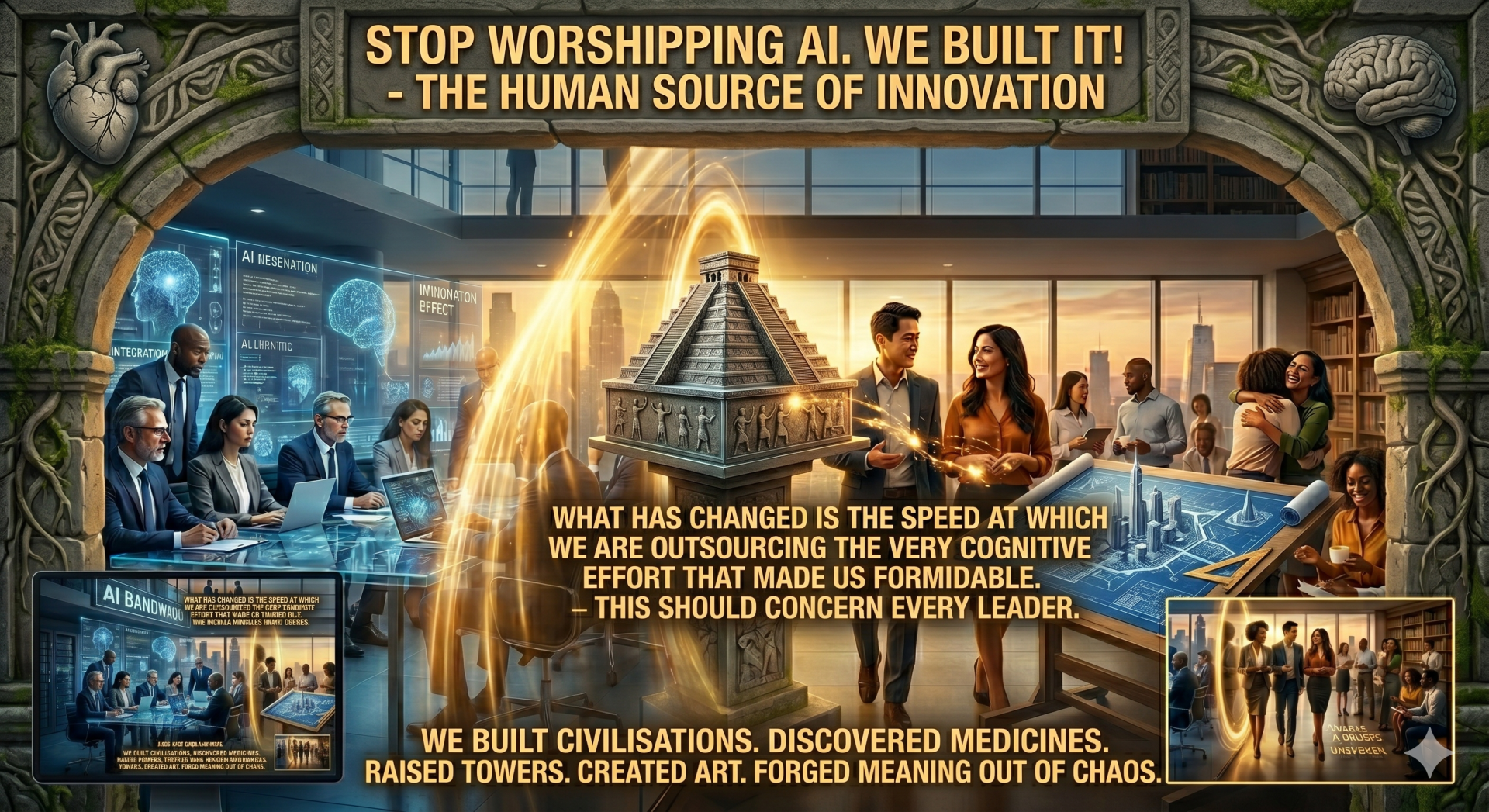
It didn’t fall from the sky. It didn’t evolve in the wild. Artificial intelligence is the product of human imagination — accumulated across generations, each mind standing on the shoulders of the last, amplifying a spark until it became the roaring flame it is today.
And yet, here we are. Handing our thinking over to it.
That should concern every leader who has a stake in shaping a better future personally, professionally and globally.
We are the species that built civilisations, discovered medicines, raised towers, created art, and forged meaning out of chaos. Our intelligence has always been a double-edged sword — capable of destruction when misapplied, and of extraordinary value when directed at improving the human condition. That hasn’t changed. What has changed is the speed at which we are outsourcing the very cognitive effort that made us formidable.
The research is not reassuring. A 2024 study from TU Munich found that while AI users experienced lower cognitive load, they produced lower-quality reasoning and argumentation — the thinking felt easier because the hard part was being done for them.¹ A 2025 review published in Societies found a negative correlation between frequent AI use and critical thinking abilities — heavy users struggling more with independent reasoning.² A broader review in INNOVAPATH identified three mechanisms quietly eroding us: reduced cognitive effort through offloading, diminished metacognitive monitoring, and altered practice patterns.³ Other research findings indicate that while AI may help immediately, it may ultimately degrade long-term misinformation detection abilities and good judgement.
We are getting faster. We are not getting sharper.
So how do C-suite leaders stay human, intelligent, and competent in this rapidly evolving technological frontier?
- Think before you prompt.
Before you ask AI for an answer, write down your own. Not for efficiency — for discipline. The moment you skip your own reasoning, you begin to atrophy it. - Protect your deep work.
Block time for unassisted thinking. Strategy, judgment, and ethical decision-making are not tasks to delegate to a machine. They are your core competencies as a leader. - Interrogate AI outputs, don’t consume them.
Treat every AI-generated response as a first draft from a junior analyst. Push back. Look for gaps. Ask what’s missing. Your critical faculties only stay sharp if you use them. - Stay emotionally present.
AI cannot read the room, sense what’s unspoken, or hold a person through uncertainty. Your EQ is not a soft skill. In an age of automation, it is your most differentiated asset. - Keep learning hard things.
Read challenging material. Engage in complex conversations. Resist the shortcut. Cognitive endurance — the capacity to sustain effortful thinking — is trainable, and research confirms it functions as genuine human capital.⁴
We created AI to extend our capabilities, not replace our thinking. The leaders who thrive in this era will be those who use it as a tool, not a crutch — and who never forget that the most powerful intelligence in any room is still, unapologetically, human.
Please share your experiences with AI. How has it helped and how has it impeded your productivity and job satisfaction?
Follow me on Instagram: @fayniewiadomski